100% factory calibration
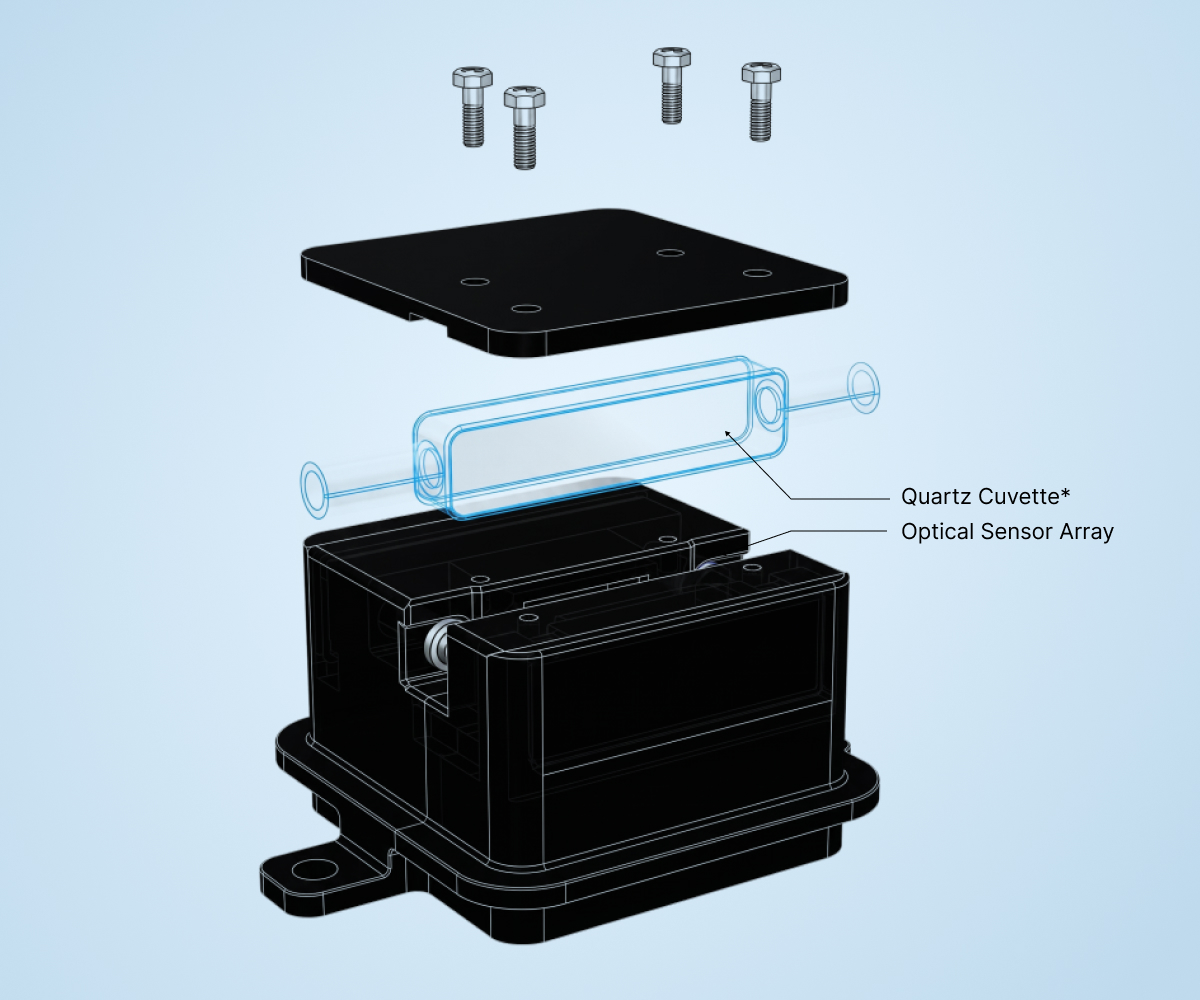
Adoption of a robust quartz cuvette
Data output includes: Blood concentration, Blood leakage threshold determination, Monitor of UV and Near IR absorption, Monitor of Disinfection Fluid’s temp.
The combined BLD & Dialysis Dose Monitor is a non invasive optical sensor probe designed to detect the smallest amounts of blood, as well as the concentration of urinary excreted substances in the spent dialysate fluid.
The sensor probe adopts two light sources in the Ultraviolet spectrum range and one light sources in the near Infrared spectrum range in order to provide the best detection sensitivity for both the blood leak (according to IEC 60601-2-16:2008) and Uric Acid concentration.
| Technical Specification | Value |
|---|---|
| Data communication | serial communication via RS232 or USB |
| Power supply | +5V ±5% @200mA |
| Fluid temperature | 25 – 90 [°C] |
| Expected Service Life | 10 years |
| Storage temperature | -20 – +60 [°C] |
| Response Time | 5 [s] at T90 |
| Standards | Safety req.: IEC 60601-2-16:2008 EMC: IEC 60601-1-2:2014 |
| Operating temperature | 10 – 50 [°C] |
| Dialysate Flow rate range | 0,1 – 2,0 [l/min] |
| Parameter BLD & DDM | Value |
|---|---|
| Change in UV absorption | 0.1–3 [arbitrary units] which correlates to decrease in Uric Acid concentration |
| spKT/V and URR | calculated by the HD equipment from UV absorption data |
| Blood concentration in dialysate | 0,05 – 1 [‰] |
| Sensitivity | 0,05 [‰] |
| BLD Status Code | 0: no blood leak 1: blood leak |
| Dialysate Temperature | range 25°C - 90°C, accuracy ± 2°C |
A typical on-line curve where UV-absorbance is plotted versus time.
The evolution of Kt/V parameter is estimated minutes by minute either during treatment and confirmed at the end of the treatment from the slope of the logarithmic plot of the on-line absorbance values.
Here on the graph the slope of the absorbance fitting curve Sa is -0.0055, so the Kt/V values for a 270 minutes long dialysis can be obtained as (Kt/V)a = – Sa *t = 0.0055*270 = 1,48